Also Known As: Yellow Blotch Rabbitfish, Orange Spotted Spinefoot
Compatibility and Behavior
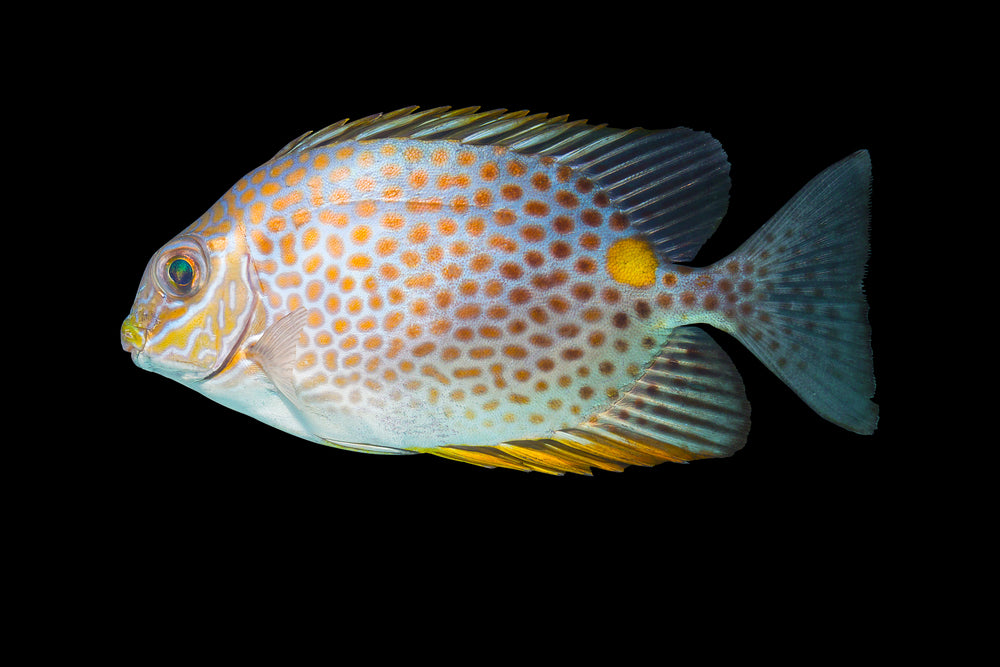
The Orange Spotted Rabbitfish (Siganus guttatus) is a deep-bodied, grazer with a dusky blue to pale gray upper body fading to silvery below, covered across the flanks in large golden-brown to orange spots separated by a fine network of blue lines. Its most reliable ID feature is the prominent pale yellow blotch just below the rear base of the soft dorsal, which sets it apart from the similar S. lineatus whose sides carry continuous bronze bands rather than spots.
Note on stress coloration: like other rabbitfish, this species can drop its bright coloration almost instantly and switch to drab mottled camouflage when sleeping or startled, so a suddenly dull fish is usually just resting rather than sick, and the color returns as it settles. These are active, peaceful grazers that patrol the rockwork all day picking at algae, and many reefers appreciate their appetite for nuisance growth like hair algae and bubble algae. It's reef safe with caution: a well-fed specimen generally leaves corals alone, but an underfed one may nip soft corals, LPS polyps, sponges, tunicates, and macroalgae, so keeping the greens in constant supply is the best safeguard. Compatibility is straightforward, since their venomous spines command respect from even assertive fish, so they mix comfortably with tangs, angelfish, wrasses, and gobies, while very small or timid tankmates may be intimidated by their eventual size. Handling requires genuine care, as the dorsal, anal, and pelvic spines are venomous and can inflict a painful sting, so track where the fish is during maintenance and move it with a rigid container rather than a net.
Aquarium Requirements
The small to medium specimens available can be grown out in a 75 gallon tank, but this species gets big, so a permanent home of 125 gallons or larger with at least 18 inches of front-to-back width should be part of the plan from the start. Balance the layout between generous open swimming lanes and mature live rock offering both grazing pasture and crevices to wedge into at night, since a secure resting spot noticeably improves how relaxed the fish behaves. A sand substrate suits it, moderate flow with good surface agitation reflects the coastal lagoons and reef flats it comes from, and moderate to strong lighting is welcome since it encourages the algae film it grazes. Supplement grazing with dried nori or Ulva on a clip at least three times a week, along with spirulina flakes, algae wafers, and prepared herbivore foods, offering only occasional meaty items since heavy protein isn't ideal for them. A tight-fitting lid is recommended, as this species has a reputation for jumping when spooked.
Specifications
Approximate Size: SMd: 2–2.5", Md: 2.5–3"
Diet: Herbivore; dried nori and Ulva on a clip, spirulina flakes, algae wafers, and prepared herbivore preparations, supplemented by natural algae grazing on live rock, with occasional mysis or brine shrimp, fed 2–3 times daily
Origin: Eastern Indian Ocean and Western Pacific
Care Level: Moderate
Reef Safe: With caution
Temperament: Peaceful
Special Considerations: Venomous dorsal, anal, and pelvic spines can inflict a painful sting, so handle with care and move it in a rigid container rather than a net. Reef safe with caution, as an underfed fish may nip corals, so keep it well grazed on greens.