Blue Spotted Stingray EXPERT (Taeniura Lymma)
Also Known As: Bluespotted Ribbontail Ray, Blue Dot Stingray
Compatibility and Behavior
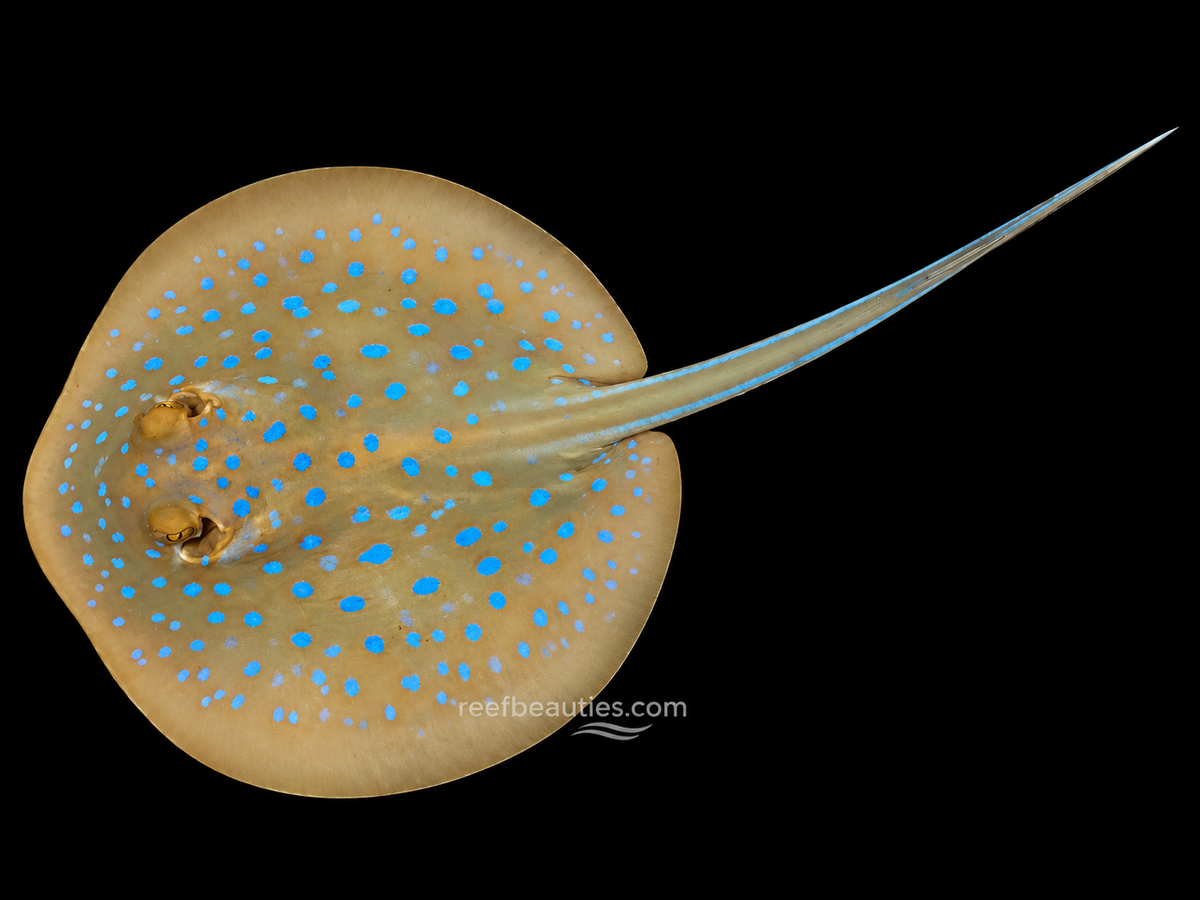
The Blue Spotted Stingray (Taeniura lymma) is one of the most striking animals in the entire trade, a smooth, oval pectoral disc in golden yellow to olive-gray scattered with vivid electric blue spots, giving its namesake. Large eyes sit high on the head for an alert profile, and unlike many rays that stay permanently buried, this one tends to remain active, cruising the sand flats and reef margins in search of worms, shrimp, and small crustaceans. Please note that this is an expert-level species, with success sometimes depending on a purpose-built system, a reliable source of live and fresh seafood, and patient feeding. Toward tankmates it's peaceful and non-aggressive, but it is not reef safe, since it'll eat ornamental shrimp, crabs, snails, other sand-bed inverts, and any small fish it can catch. The best companions are peaceful, mid-to-upper water fish too large to be eaten and with no nipping history, like tangs, rabbitfish, and larger peaceful angelfish, while triggerfish, puffers, and aggressive nippers must be avoided, since damage to the delicate disc invites bacterial infection. Skip bottom-dwelling sand sifters like diamond gobies too, as they compete for the same territory. Two safety notes to take seriously: the tail carries venomous barbs and demands respect during maintenance, and this species is extremely sensitive to copper, so copper-based medications must never be used.
Aquarium Requirements
For a ray, footprint matters far more than volume, since it swims by undulating its whole disc and needs turning radius rather than depth. Juveniles in the 4 to 7 inch disc range can start in a 150 to 180 gallon system, but a mature specimen requires 250 to 300 gallons or more with a footprint of at least 6 feet by 3 feet, and wider is always better, so plan the upgrade path before you buy. Rectangular tanks with sharp corners cause rays to bump and abrade the leading edge of the disc, so oval or wide, shallow layouts are preferable. A deep bed of sugar-fine aragonite, 2 to 3 inches across the entire bottom with a grain size around 0.5 to 1.5 millimeters, is non-negotiable, since crushed coral, angular grains, or shell fragments will abrade the underside of the disc and invite infection. Keep the layout largely open with minimal rockwork, though one secure ledge or overhang gives the ray a place to shelter. Oversized filtration with a large protein skimmer and strong surface agitation is essential, since elasmobranchs have high oxygen demand and are unusually sensitive to nitrogenous waste, and RO/DI water plus generous water changes should be standard practice. Screen or cover all pump intakes and use a secure lid, as rays can climb the glass and may go over the edge. To establish feeding, offer live ghost or grass shrimp released onto the sand or live blackworms near the resting spot, then gradually transition to tong-fed fresh seafood (they love chopped squid) once a reliable response develops.
Specifications
Approximate Size: 4–7" diameter, not including tail
Diet: Carnivore; begin with live grass or ghost shrimp and marine worms, then transition to fresh chopped shrimp, scallop, squid, clam, and marine fish flesh fed by tongs, offered daily for juveniles
Origin: Indo-West Pacific
Care Level: Expert only
Reef Safe: No
Temperament: Peaceful and non-aggressive toward appropriately sized tankmates
Minimum Tank Size: 150 gallons for juveniles, with 250–300 gallons or more required as it grows
Special Considerations: Venomous tail barbs require careful handling; extremely sensitive to copper, so copper medications must never be used; screen pump intakes and use a secure lid
Pairs well with
Blue Spotted Stingray EXPERT (Taeniura Lymma)
If you have any questions, you are always welcome to contact us. We look forward to hearing from you!
-
Shipping Information
- Our shipping days are Monday-Thursday. Orders will be shipped overnight on the soonest possible shipping day, unless you request to hold the order for up to one business day.
- Your order will ship same-day if placed before 12:30 PM PST on a shipping day.
- Orders placed after 12:30 PM PST will ship on the next shipping day.
- Stay tuned to our Announcement Bar (black bar at the top of every page) for important shipping announcements...we may reach our max limit of orders we can ship on Mondays.
- If it is very hot, very cold, or if you live in a rural area, ship to a UPS Access Point to save your livestock from hours of exposure to the elements. Click here to see how.
-
FAQ’s
When will you ship my order?
We will ship on the soonest possible shipping day. Our shipping days are Monday-Thursday, and we ship same-day if the order is placed before 12:30 PM PST (unless announced otherwise). For example, if ordering at 1 PM on Thursday, your order will ship the following Monday.
Can you hold my order until next week?
Unfortunately not. We can hold items for up to one business day before shipping. We restock weekly, so chances are good we will receive more by next week!
When is the best time to order?
Saturdays and Sundays are the absolute best time to order, followed by Wednesday evenings. The closer you order to an inventory update, the better the available inventory.
What happens if something I ordered is unavailable?
We will email you to request a substitution. If you would like your original order, chances are good that it will be available to ship within the week (unless it is a very rare item).
Can I modify my order once it has been placed?
This is possible, but not guaranteed. Please email us if you need to modify your order or shipping address, and we will gladly make the changes for you, or let you know if it is too late.
What should I do if UPS is unreliable in my area?
We recommend shipping to a UPS Access Point, as packages get delivered there first before trucks go on residential deliveries. Click here to see how.
What salinity do you ship at?
Salinity for fish is 1.018-9. Salinity for inverts is 1.024-5.
-
Contact Us
Send us an email at sales@reefbeauties.com and we will get back to you shortly.
We do not offer phone calls. We handle our inquiries with timely emails to ensure a qualified and high-quality response, to have all conversations on record, and to avoid miscommunications that can occur over the phone.
Free shipping on orders over $199!
FAQs
Frequently Asked Questions
When will you ship my order?
We will ship on the soonest possible shipping day. Our shipping days are Monday-Thursday, and we ship same-day if the order is placed before 12:30 PM PST (unless announced otherwise). For example, if ordering at 1 PM on Thursday, your order will ship the following Monday.
Can you hold my order until next week?
Unfortunately not. We can hold items for up to one business day before shipping. We restock weekly, so chances are good we will receive more by next week!
When is the best time to order?
Saturdays and Sundays are the absolute best time to order, followed by Wednesday evenings. The closer you order to an inventory update, the better the available inventory.
What happens if something I ordered is unavailable?
We will email you to request a substitution. If you would like your original order, chances are good that it will be available to ship within the week (unless it is a very rare item).
Can I modify my order once it has been placed?
This is possible, but not guaranteed. Please email us if you need to modify your order or shipping address, and we will gladly make the changes for you, or let you know if it is too late.
What should I do if FedEx is unreliable in my area?
We recommend shipping to a FedEx Ship Center, as packages get delivered there first before trucks go on residential deliveries. Click here to see how.
What salinity do you ship at?
Salinity for fish is 1.018-9. Salinity for inverts is 1.024-5.